
MALAYALAM PLAY
The Recurring Rhythm
The Source
In a crumbling tharavad in rural Kerala, one family lives under the grip of a curse — or so they believe. Generations ago, an ancestor desecrated the family deity, and since then, one person in every generation is said to descend into madness. When the latest “cursed” family member dies chained in a dark room, the village turns its gaze to the next generation: Balan, a quiet, well-liked schoolteacher, and his younger brother Gopi.
One nightmare is all it takes. Balan wakes the household screaming in the night, and the machinery of superstition clicks into motion. The family matriarch — the eldest and most powerful figure in this matrilineal household — sees confirmation of the curse. The village agrees. Every ordinary gesture Balan makes is reread as evidence of insanity. His students mock him. His wife and children are sent away. His sister’s marriage is arranged in secret, lest the family’s shame become public.
Gopi, educated and rational, fights back. He takes Balan to a doctor, who declares him perfectly sane. But a medical certificate is no match for collective belief. The matriarch — who genuinely loves Balan, who raised him, who holds the family together with an iron will forged from grief and tradition — cannot accept the doctor's word. To do so would mean dismantling the very structure of meaning that has governed her life and her mother’s life before her. The curse must be real, because if it isn’t, then the suffering of every “mad” relative before Balan was pointless.
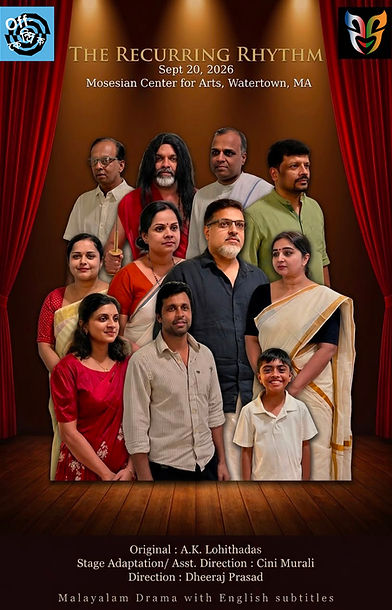
Original play by A.K. Lohithadas
Adaptation: Cini Murali
Director: Dheeraj Prasad
Balan is committed to an asylum. He returns broken — physically, spiritually — and is confined to the same dark room, the same chains. The cycle completes. His mother, unable to watch her son live as a caged animal, poisons his final meal and then takes her own life.
The Adaptation
The original 1987 film placed the Karanavar — the eldest uncle — as the seat of family authority. In this stage adaptation, that role is reimagined as a woman: the family matriarch. In Kerala’s matrilineal tradition, property and lineage pass through the mother’s line, yet historically, power was still wielded by men. This adaptation corrects that contradiction and, in doing so, deepens it. The matriarch is not a villain. She is a woman who has survived by believing in the system that also imprisoned her. Her authority — hard-won, fragile, rooted in ritual — becomes the very instrument of Balan's destruction. The play asks: what happens when the person most capable of breaking a cycle is also the one most invested in its continuation?
Thaniyavarthanam is a story about how communities manufacture madness, how love and cruelty coexist in the same hand, and how superstition survives not because people are ignorant, but because abandoning it would cost them everything they’ve built their identity upon.